

Gaming PC for Beginners Made Simple in 2026
- Jul 18
- 6 min read
The first gaming PC should feel exciting, not like an exam in computer parts. You do not need to memorise every graphics card name or build a machine yourself to play the games you enjoy. A gaming PC for beginners simply needs to suit your games, your screen and your budget, while leaving enough room to grow when your interests change.
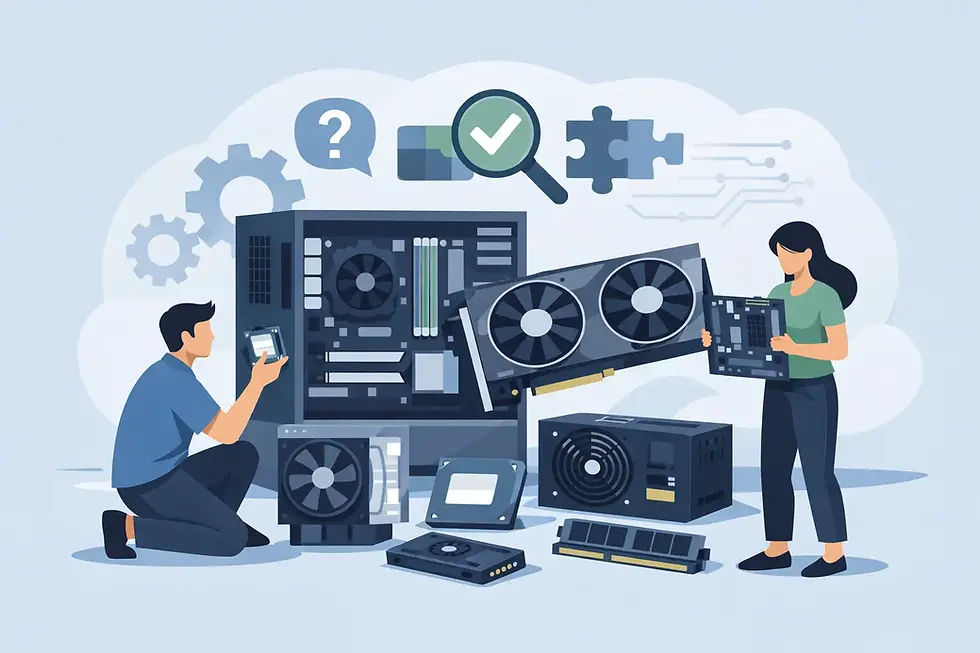
The biggest mistake is buying based on one impressive-sounding specification. A high processor number, large amount of storage or colourful case will not automatically produce better gaming performance. Think about the whole system instead: the processor, graphics card, memory, storage, cooling and power supply need to be balanced for the job.
Start with the games and screen you actually use
Before looking at PCs, make a short list of the games you play or want to play. Competitive titles such as Fortnite, Valorant, Rocket League and Minecraft have very different demands from visually detailed games such as Cyberpunk 2077, Microsoft Flight Simulator or recent open-world releases.
Your monitor matters just as much. A 1080p Full HD screen is still an excellent starting point and makes good gaming performance more affordable. At this resolution, an entry- or mid-range graphics card can deliver smooth frame rates in a broad range of games. A 1440p monitor has a sharper image but asks more from the graphics card. 4K gaming needs considerably more graphical power and is usually not the sensible place to begin on a tight budget.
Refresh rate is the other part of the picture. A 60Hz display refreshes the image 60 times a second, while 144Hz or 165Hz screens can make fast movement feel noticeably smoother when your PC can provide enough frames. For competitive games, it can be worth prioritising a capable 1080p system and high-refresh monitor over stretching the budget for a higher resolution screen.
The parts that matter in a gaming PC for beginners
The graphics card does most of the gaming work
For most gaming systems, the graphics card is the main driver of visual quality and frame rate. It is the component worth protecting in your budget. A better graphics card can often make a greater difference in games than moving to a much more expensive processor.
That does not mean choosing the most expensive card available. The right option depends on your target resolution and the games you play. A well-matched graphics card for 1080p gaming is better value than paying for 4K-level performance you will not use. It is also worth checking the amount of video memory, particularly if you expect to play newer, more demanding games over the next few years.
The processor keeps everything moving
The processor, or CPU, handles game logic, background tasks and the work that supports your graphics card. Modern AMD Ryzen and Intel processors both offer strong options for first-time gaming buyers. The practical aim is to choose a current, capable processor that will not hold back the graphics card.
For a gaming-focused machine, you do not need the highest core count available. Spending too heavily on the processor and too little on the graphics card can leave you with weaker gaming results. Extra processor power becomes more useful if you also plan to stream, edit videos, run demanding creative software or use the PC for CAD work.
Memory and storage should not be afterthoughts
16GB of RAM is a sensible baseline for a modern gaming PC. It gives games and Windows enough breathing room and avoids the frustration of closing every browser tab before launching a game. 32GB can be worthwhile for heavier multitasking, content creation or buyers who want more headroom, but it is not essential for every first system.
An SSD is equally important. It makes Windows feel responsive and cuts game loading times compared with an older mechanical hard drive. A 1TB SSD is a comfortable starting point for many players because game installations can be large. If your library grows, additional storage can often be fitted later, so do not compromise the graphics card simply to buy a huge amount of storage on day one.
Set a budget with the full setup in mind
A PC is only part of the cost if you are starting from scratch. Allow for a monitor, keyboard, mouse, headset or speakers, and possibly a copy of Windows if it is not included with your chosen system. It is better to set aside a realistic amount for the complete setup than buy a strong PC and use it with an unsuitable old display.
There is no single correct budget. Entry-level gaming PCs can be a good fit for esports titles, indie games and Full HD play with sensible settings. Mid-range systems usually offer more flexibility for demanding games, higher settings and better longevity. The important question is not whether a PC is labelled “budget” or “premium”, but whether its specification matches what you expect it to do.
Be wary of offers that lead with a low price but hide weak core components. A system with very little RAM, a small SSD, an unbranded power supply or an older graphics card may look attractive initially but can be harder to live with. Clear component information is a good sign that you are comparing systems properly.
Prebuilt, custom or self-built?
Building a PC yourself can be rewarding, but it is not a requirement for owning a good gaming machine. A ready-built system removes compatibility worries and means the computer has been assembled, tested and prepared before it reaches you. For many beginners, that reassurance is worth more than the small saving that may be possible by sourcing each component separately.
A custom-configured PC sits between a standard prebuilt and a full do-it-yourself build. You can begin with a proven base specification, then adjust areas that matter to you, such as storage, memory, Wi-Fi, case style or graphics performance. This approach makes sense when you have a particular game, monitor or budget in mind but do not want to take responsibility for every compatibility decision.
Self-building is best suited to buyers who enjoy the research and are comfortable troubleshooting. It can give you full control, but the true cost includes your time, tools and the possibility of resolving an issue if a part arrives faulty or a system will not boot. There is no prize for choosing the difficult route.
Check what support comes after the purchase
A gaming PC is not just a box delivered to your door. Ask what happens if you need advice before ordering, want to change a specification, or develop a fault later. Clear warranty terms and access to real technical support can be especially valuable for a first-time buyer.
At Skull Computers, systems are carefully built around the intended use and supported with a three-year parts-and-labour warranty. Having a workshop-backed retailer also gives you a practical route for repairs and upgrades rather than leaving you to diagnose a problem alone. If a standard system is nearly right, asking about a specification change can be a better decision than settling for a compromise.
It is also sensible to think ahead about upgrades. Memory and storage are commonly straightforward additions, while a future graphics card upgrade may depend on the power supply, case space and cooling. A well-built starting system gives you options, but do not pay for theoretical upgrade potential that you are unlikely to use.
Avoid these common first-buying mistakes
Do not choose a PC solely because it has the word “gaming” in the name. Read the actual processor, graphics card, RAM and storage specification. Marketing labels are useful for browsing, but the parts determine the experience.
Do not assume maximum game settings are the only measure of success either. A game that looks good and runs smoothly at high settings is more enjoyable than one pushed to ultra settings with inconsistent frame rates. Features such as resolution scaling and sensible graphics settings can extend the life of a system without making games look poor.
Finally, do not forget the practical details. Check that the PC has the connections you need for your monitor and accessories, whether it includes Wi-Fi if you cannot use an Ethernet cable, and where you will place it for good airflow. A desktop needs space around its vents, not a tightly enclosed cupboard.
The right first PC is the one that makes you want to sit down and play, not the one with the longest specification sheet. Choose for the games and screen you have now, leave sensible room for tomorrow, and buy from people who can help when the questions start after delivery.


Comments